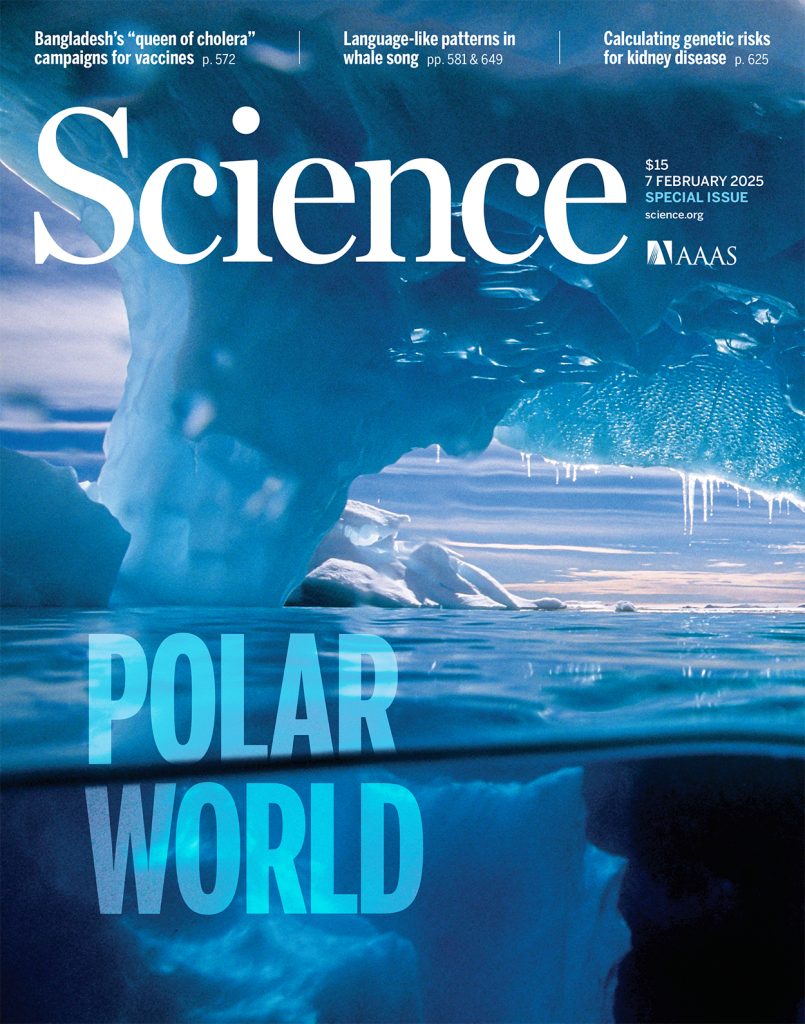
Feb 7, 2025: The Polar Special Issue of Science, coordinated in part by CliC, is available now. Thank you and congratulations to all the authors who participated! Find more information about the reviews coordinated by CliC below.
Antarctica in 2025: Drivers of deep uncertainty in projected ice loss
Authors: Helen Amanda Fricker, Benjamin K. Galton-Fenzi (CliC SSG), Catherine Colello Walker, Bryony Isabella Diana Freer, Laurie Padman, Robert DeConto (Ex Officio CliC SSG)
Abstract: Antarctica is a vital component of Earth’s climate system, influencing global sea level, ocean circulation, and planetary albedo. Major knowledge gaps in critical processes—spanning the atmosphere, ocean, ice sheets, underlying beds, ice shelves, and sea ice—create uncertainties in future projections, hindering climate adaptation and risk assessments of ice intervention strategies. Antarctica’s ice sheet could contribute 28 centimeters to sea level by 2100, and potentially more if we surpass warming thresholds that trigger instabilities and rapid retreat. We review recent advances in understanding the changing stability of the ice sheet margins and identify key processes that require further research. Progress requires high-resolution satellite data, targeted field campaigns, improved modeling, and refined theory. Increased investment and interdisciplinary collaboration are essential to uncovering Antarctica’s hidden processes and reducing uncertainties in future projections.
Disappearing landscapes: The Arctic at +2.7°C global warming
Authors: Julienne C. Stroeve, Dirk Notz (SIMIP), Jackie Dawson, Edward A. G. Schuur (Permafrost Carbon Network), Dorthe Dahl-Jensen, Céline Giesse
Abstract: Under current nationally determined contributions (NDCs) to mitigate greenhouse gas emissions, global warming is projected to reach 2.7°C above preindustrial levels. In this review, we show that at such a level of warming, the Arctic would be transformed beyond contemporary recognition: Virtually every day of the year would have air temperatures higher than preindustrial extremes, the Arctic Ocean would be essentially ice free for several months in summer, the area of Greenland that reaches melting temperatures for at least a month would roughly quadruple, and the area of permafrost would be roughly half of what it was in preindustrial times. These geophysical changes go along with widespread ecosystem disruptions and infrastructure damage, which, as we show here, could be substantially reduced by increased efforts to limit global warming.