CliC SSG 11 in Boulder
The 11th Session of the Climate and Cryosphere Project's Scientific Steering Group was hosted by Marika Holland and SSG Member…

The 11th Session of the Climate and Cryosphere Project's Scientific Steering Group was hosted by Marika Holland and SSG Member…
- The Permafrost Carbon Network is a CliC sponsored activity 71 abstracts was received for the AGU session about the Vulnerability of…
The Resources Team and the Hydrology Team of the Arctic Freshwater Synthesis Targeted Activity will meet from the 14-16 September…
We are pleased to announce an open call for expressions of interest to participate in a workshop on 'Large-scale climate…
 Professor Tim Palmer, former co-chair of CLIVAR SSG, has been honoured in this year's Institute of Physics Awards for the development of probabilistic weather and climate prediction systems. Awarding Professor Palmer the Dirac Medal 2014, which recognises outstanding contributions in theoretical physics, is a recognition of the importance of the fields of weather and climate for all sections of society... read more
Future Earth will have a new secretariat with a unique and innovative structure that spans three continents. The preferred bidders comprises five global hubs which will function as a single entity, and are located in Canada, France, Japan, Sweden and United States. This includes a series of regional hubs, from which it is expected new regional networks will develop, these covers, Latin America, the Middle East and North Africa, Europe and Asia. The secretariat will support five core functions: coordination, communication and outreach, research enabling, capacity building, synthesis and foresight... read more

Dr. Ghassem Asrar, former WCRP Director, has been named a 2014 Ambassador for the American Geophysical Union (AGU) in recognition for "outstanding contributions to societal impact, service to Earth and space community, scientific leadership and promotion of talent/career pool. " The Award honors up to five outstanding scientific leaders per year... read more
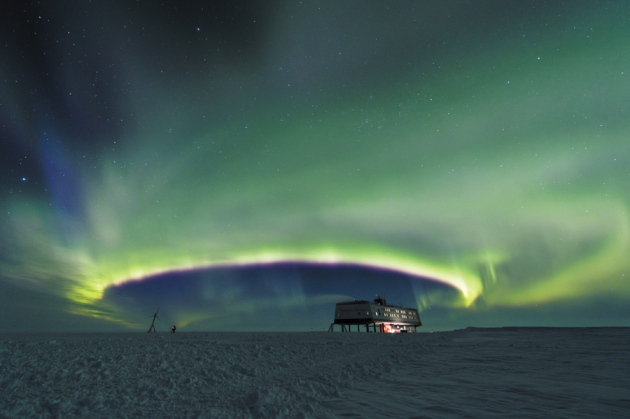 - Rob Massom and Jenny Baeseman represented the CliC Community through this process
The official outcomes of the 1st SCAR Antarctic and Southern Ocean Science Horizon Scan were published online today as a COMMENT in Nature (512, 23–25; 2014 http://www.nature.com/news/1.15658) entitled “Six priorities for Antarctic science”.
In April 2014, the Scientific Committee on Antarctic Research (SCAR) convened 75 scientists and policy-makers from 22 countries to agree on the priorities for Antarctic research for the next two decades and beyond. This is the first time the international Antarctic community has formulated a collective vision through discussions, debate and voting. The Horizon Scan narrowed a list of hundreds of scientific questions to the 80 most pressing ones.
The questions fall broadly into six scientific priorities:
1) define the global reach of the Antarctic atmosphere and Southern Ocean;
2) understand how, where and why ice sheets lose mass;
3) reveal Antarctica’s history;
4) learn how Antarctic life evolved and Survived;
5) observe space and the Universe; and
6) recognize and mitigate human influences.
- SOOS is a CliC Endorsed Project SOOS will be running a lunchtime Town Hall meeting alongside the SCAR Open…
- The Permafrost Carbon Networl is a Clic sponsored activity Vulnerability of Permafrost Carbon to Climate Change (session ID#: 2294)…