Belmont Forum webinar

The Belmont Forum is hosting a second researcher matching webinar on Tuesday, June 3rd, from 12pm-1:30pm Eastern Time that focuses on the breadth of end users and best practices for engagement of end users in the development and implementation of research projects.  The webinar features a panel of experts representing a variety of end user perspectives and organizations.  Webex details, including a link to international dialing options, are below.  Slides will be shown via Webex and discussion will be handled via the international phone lines provided.  
 
End users provide a required expertise on Belmont Forum proposals.  The term "end user" encompasses a variety of organizations in citizen, indigenous, policy, government, academic, industry, advocacy, and managerial domains.  The panel represents a cross-cut of end users and representative organizations active in Arctic natural and social science research.  
 
A moderated panel discussion will be followed by a Q&A session.  Panelists for the June 3rd event include:
 
Christina Anderson, Willow Environmental LLC
Jim Gamble, Aleut International Association
Eva Kruemmel, Inuit Circumpolar Council
Gordon McBean, Centre for Environment and Sustainability, Western University / President-elect International Council for Science
Zach Stevenson, Northwest Arctic Borough
Aki Tonami, Nordic Institute of Asian Studies, University of Copenhagen  
 
The webinar will be recorded and made available on the ArcticHub (http://www.arctichub.net) after the event under the Long-Term Observing Management Discussion Group.  
 
Join the ArcticHub today and utilize the “help wanted ads” functionality to connect with other researchers and end users to submit a proposal to the Belmont Forum.  This researcher matching capability allows you to post messages looking for collaborators or offering your expertise to a proposing team.  Additional researcher matching to can be sought through the Belmont Forum website: https://www.igfagcr.org/user/register.
 
1. Go to https://nsf.webex.com/nsf/j.php?MTID=m56d7d10f5c7fd33bde94a3e9c9795568
2. If requested, enter your name and email address. 
3. If a password is required, enter the meeting password: arctic 
4. Click "Join". 


Continue ReadingBelmont Forum webinar

Call for Membership – New NSF-Funded Network in Arctic Sustainability Arctic-FROST

The new US National Science Foundation (NSF)-funded Research Coordination Network (RCN) - Sustainability Science, Engineering, and Education for Sustainability (SEES) network, entitled "Arctic-FROST: Arctic FRontiers Of SusTainability: Resources, Societies, Environments, and Development in the Changing North" announces a call for membership.

Arctic-FROST is an international interdisciplinary collaborative network and platform for research exchange, developing interdisciplinary synthesis, and international research about Arctic and sub-Arctic sustainability. The network teams together environmental and social scientists, local educators, and community members to enable and mobilize research on sustainable Arctic development. The research is specifically aimed at improving health, human development, and the well-being of Arctic communities while conserving ecosystem structures, functions, and resources under changing climate conditions. The network is based at the Arctic Social and Environmental Systems Research Laboratory at the University of Northern Iowa under the direction of Andre Petrov.

Over the next five years Arctic-FROST will fund multiple meetings and workshops on various subjects pertaining to sustainability and sustainable development in the Arctic. Community members with academic or practical interests in these areas are invited to become Arctic-FROST members. Arctic-FROST membership is free and open for all. Membership benefits include:

  • Opportunity to connect with network researchers and receive interdisciplinary and international collaboration experience;
  • Eligibility for funding to participate in Arctic-FROST activities and events;
  • Access to special workshops and funding for early career scholars;
  • Ability to receive members-only research updates, announcements, teaching materials, calls for papers and proposals, and other network-related information; and
  • Priority in submission of papers and abstracts for Arctic-FROST sponsored publications and activities.

For further information and to register, go to: http://www.uni.edu/arctic/frost.

For questions, contact: Andrey Petrov; Email: andrey.petrov@uni.edu

Continue ReadingCall for Membership – New NSF-Funded Network in Arctic Sustainability Arctic-FROST

Extreme Collaboration: Briefing from the 1st WCRP-ICTP Summer School (15.08.2014)

School Group photo

Are humans changing the length of the agricultural growing season or the number of extreme weather events? Are temperature and precipitation swings in one region of the world related to those in another? These are among the real-world research problems young scientists examined at the first WCRP-ICTP Summer School on Attribution and Prediction of Extreme Events... read more

Continue ReadingExtreme Collaboration: Briefing from the 1st WCRP-ICTP Summer School (15.08.2014)

Highlights of the 7th International Conference on GEWEX (02.08.2014)


7thGEWEXConfposterssm


Thanks to all who attended and contributed to the 7th International Scientific Conference on GEWEX. Over 560 scientists, managers, and students from 45 countries attended the Conference which addressed research on water resources, extremes in water such as droughts and floods, and new analysis from observations and data sets. There were 436 posters covering the topics of the conference... read more

Continue ReadingHighlights of the 7th International Conference on GEWEX (02.08.2014)

2012 Arctic Report Cards describe dramatic changes in the Arctic

The Arctic Report Cards produced by the National Oceanic and Atmospheric Administration (NOAA) are a source of reliable and brief information on the current state of the Arctic environment. The Arctic Council working groups CAFF and AMAP supported work on the 2012 Report Cards, which detail dramatic changes in the Arctic with record losses of sea ice and late spring snow. The Arctic Council, through the Arctic Monitoring and Assessment Programme (AMAP) and the Conservation of Arctic Flora and Fauna’s (CAFF) Circumpolar Biodiversity Monitoring Programme (CBMP), has contributed to the Arctic Report Card, an annual report released today by NOAA that monitors the often-quickly changing conditions in the Arctic.

Continue Reading2012 Arctic Report Cards describe dramatic changes in the Arctic

International Project Office for CORDEX (IPOC) hosted at SMHI (15.08.2014)

WCRP is pleased to announce that the Swedish Meteorological and Hydrological Institute (SMHI) has been selected as the host for the new International Project Office for CORDEX (IPOC). The CORDEX IPO is now looking for dedicated staff to support the CORDEX activities and establsh the linkages with the CORDEX science community... read more


Continue ReadingInternational Project Office for CORDEX (IPOC) hosted at SMHI (15.08.2014)

New datas available for Byrd Glacier

The Center for Remote Sensing of Ice Sheets (CReSIS) has posted a new radar depth sounder dataset and a new ice bottom, ice thickness, and ice surface grid for Byrd Glacier.
For radar depth sounder dataset go to:
https://data.cresis.ku.edu/ Click on “Radar Depth Sounder” link and then click on L1B and L2 link. The direct link is: ftp://data.cresis.ku.edu/data/rds/2011_Antarctica_TO/
For ice bottom, ice thickness, and ice surface grid go to: https://data.cresis.ku.edu/ Click on “Radar Depth Sounder” link and then click on L3 link. The direct link is: ftp://data.cresis.ku.edu/data/grids/Byrd_2011_2012_Composite.zip
Citation and acknowledgement information is provided on the main radar data products page: at https://data.cresis.ku.edu/#ACRDU
If you have any questions or find any problems with the dataset please contact:
cresis_data@cresis.ku.edu

Continue ReadingNew datas available for Byrd Glacier

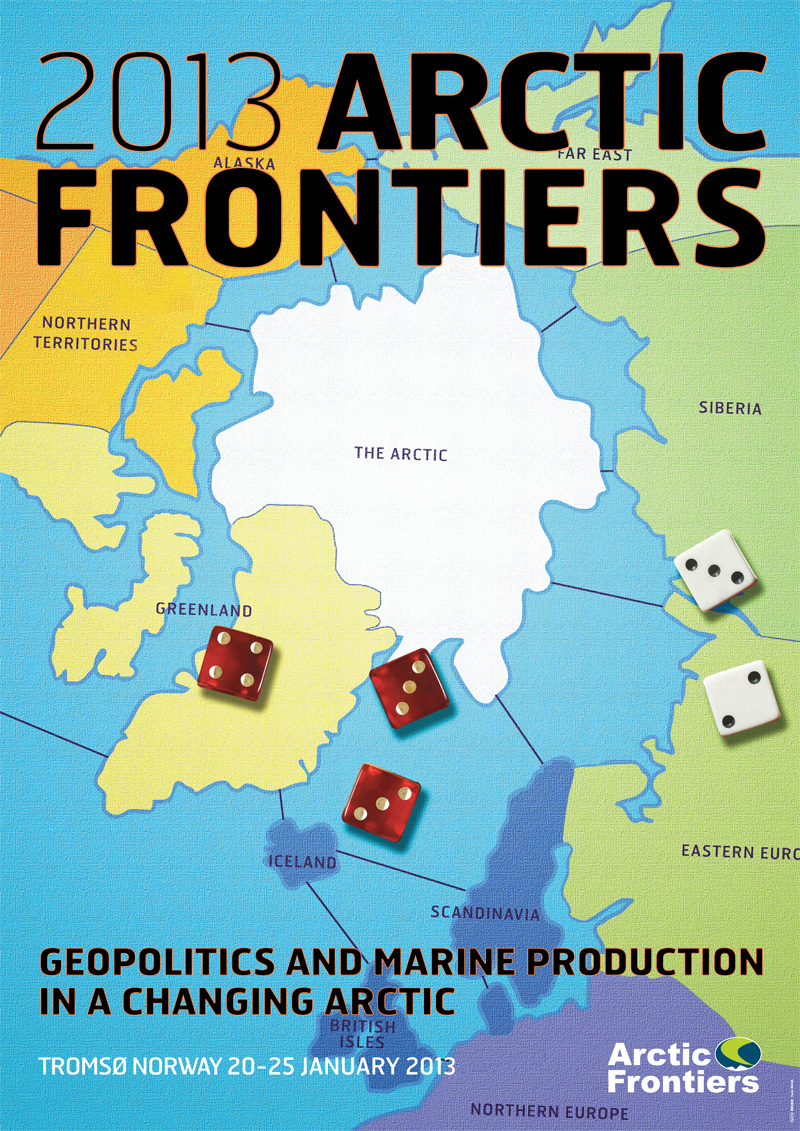
Arctic Frontiers 2013 live and streaming webTV feed available


Arctic Frontiers 2013 - Geopolitics & Marine Production in a Changing Arctic can be followed through live and streaming webTV feed available at www.arcticfrontiers.com

The 7th Arctic Frontiers conference addresses the contemporary and emerging political issues for the changing Arctic. How do states in and outside the region prepare strategically for the new Arctic reality? How does the global security architecture impact on security in the Arctic? How important is Arctic oil and gas production for global demand and the energy security of various states? How will traditional businesses interact with new industry, and if and how will profits from industrial activities benefit the people living in the High North.

Change is the keyword which best describes the future of the Arctic. A warming Arctic with less ice creates economic opportunities but it also presents new challenges for Arctic stakeholders. Join us at this year's Arctic Frontiers Conference to engage with the experts and be ready to meet the challenges that lie ahead for the Arctic.
Got to: www.arcticfrontiers.com for more information.

Continue ReadingArctic Frontiers 2013 live and streaming webTV feed available

December 2012 Issue of the Journal ARCTIC Available

The Arctic Institute of North America (AINA) announces publication of the December 2012 issue of the journal ARCTIC, Volume 65, Number 4. A non-profit membership organization and multidisciplinary research institute of the University of Calgary, AINA's mandate is to advance the
study of the North American and circumpolar Arctic through the natural and social sciences, as well as the arts and humanities, and to acquire, preserve, and disseminate information on physical, environmental, and social conditions in the North. Created as a binational corporation in
1945, the Institute's United States Corporation is housed at the University of Alaska Fairbanks.

For information on becoming an AINA member and receiving the journal, please visit the Institute's website at: http://www.arctic.ucalgary.ca/. Members have the options of receiving ARCTIC in print, online, or both in print and online.

The following papers appear in the December 2012 issue of ARCTIC:

- Shifts in Plankton, Nutrient and Light Relationships in Small Tundra
Lakes Caused by Localized Permafrost Thaw
By: Megan S. Thompson, Frederick J. Wrona, and Terry D. Prowse

- Ringed Seals and Sea Ice in Canada's Western Arctic: Harvest-Based
Monitoring 1992-2011
By: Lois A. Harwood, Thomas G. Smith, Humfrey Melling, John Alikamik,
and Michael C.S. Kingsley

- The Utility of Harvest Recoveries of Marked Individuals to Assess
Polar Bear (Ursus maritimus) Survival
By: Elizabeth Peacock, Jeff Laake, Kristin L. Laidre, Erik W. Born, and
Stephen N. Atkinson

- Serum Biochemistry and Serum Cortisol Levels of Immobilized and Hunted
Muskoxen (Ovibos moschatus) from Northern Canada
By: N. Jane Harms, Brett T. Elkin, Anne Gunn, Boyan Tracz, Jan
Adamczewski, Peter Flood, and Frederick A. Leighton

- Shorebirds Breed in Unusually High Densities in the Teshekpuk Lake
Special Area, Alaska
By: Brad A. Andres, James A. Johnson, Stephen C. Brown, and Richard B. Lanctot

- Harvest-based Monitoring in the Inuvialuit Settlement Region: Steps
for Success
By: Robert K. Bell and Lois A. Harwood

- The Naming of Kazan River, Nunavut, Canada
By: C.B. Sikstrom

- Weathering Changes: Cultivating Local and Traditional Knowledge of
Environmental Change in Tr'ondek Hwech'in Traditional Territory
By: Shirley Roburn and Tr'ondek Hwech'in Heritage Department

- Nesting Common Eider (Somateria mollissima) Population Quintuples in
Northwest Greenland
By: Kurt K. Burnham, Jeff A. Johnson, Bridger Konkel, and Jennifer L. Burnham

- Renewable Energy Policies and Programs in Nunavut: Perspectives from
the Federal and Territorial Governments
By: Nicole C. McDonald and Joshua M. Pearce

The December issue also contains an Arctic Profile of Ernest William Hawkes, written by Barnett Richling; five book reviews; a Letter to the Editor; and two obituaries, one for Geoffrey Hattersley-Smith, and the other for Richard George Bolney Brown.

The InfoNorth section of the December issue contains two essays written by the AINA 2012 scholarship winners. N. Jane Harms, the recipient of the Jennifer Robinson Memorial Scholarship, provided an update on her study of avian cholera among common eiders in the eastern Canadian
Arctic. Ann Balasubramaniam, the 2012 recipient of the Lorraine Allison Scholarship, presented her research on hydro-limnological relationships in thermokarst lakes of the Old Crow Flats, Yukon.

For information on becoming an AINA member and receiving the journal,
please visit the Institute's website at: http://www.arctic.ucalgary.ca/.

Continue ReadingDecember 2012 Issue of the Journal ARCTIC Available

“Ice and Snow” Journal on latest results of recent studies of the subglacial Lake Vostok in Antarctica available

1
Free full access (pdf) to all papers of  the last issue of the “Ice and Snow” Journal [no 4(120), 2012] is available.

This issue is devoted specifically to the latest results of recent studies of the subglacial Lake Vostok in Antarctica.

It includes 5 papers in English and 13 papers in Russian (with English summaries and figure captions) + preface and contents.
You can download the papers from “Ice and Snow” page:
  http://ice-snow.igras.ru/index.php?r=312&id=2521 clicking on relevant links,
or more simply from this open public folder:
 https://docs.google.com/folder/d/0BySErXCOSTGDczU3MXptbmhPeFk/edit

Continue Reading“Ice and Snow” Journal on latest results of recent studies of the subglacial Lake Vostok in Antarctica available